

Imam Shamil

Kerim Fenari
The Chechen peoples desperate struggle for freedom has taken many Muslims by surprise. As with Bosnia three years ago, the very existence of this Muslim country was unknown to many in our community. But now, as the savage hordes of Tsar Boris the First pour down from the barbarian lands of the north to bring fire and the sword to the Chechens, it is worth remembering that the Caucasus has always been the graveyard of Christian invaders and the birthplace of Muslim heroes whose names still resound in the forests and valleys of that most romantic of all mountain lands.
The Caucasus, a sheer rampart which divides Europe from Asia, is like no other mountain range on earth. The highest peaks in Europe are here, compared to which the Alps seem like the merest pimples. Stretching for 650 miles from the Caspian to the Black Sea, their average height is over 10,000 feet. This spectacular prospect is made still more forbidding by the vertiginous steepness of the slopes. The Caucasus is a man its body is without curves, says a Georgian proverb, and cliffs, dropping in places more than five thousand feet into icy torrents, seem to dissect the landscape into sheer blocks of stone.
The very impenetrability of the Caucasus, and the difficulty of internal communication, have allowed countless different peoples and tribes to dwell here. The historian Pliny tells us that the Romans employed a hundred and thirty-four interpreters in their dealings with the warlike Caucasian clans; while the Arab historian al-Azizi dubbed the region the Mountain of Languages, recording that three hundred mutually-incomprehensible tongues were spoken in Daghestan alone.
Some of the Caucasian peoples, such as the fair-skinned Chechens, are descendants of ancient migrants from Europe. Others, including the Daghestanis, are believed to be of Asian origin. But the harsh climate and impossible terrain have imposed a similar ascetic lifestyle on them all. Little agriculture is possible on the dizzying slopes, and only on the highest plateaus can sheep be husbanded with any success. Traditionally, the people lived in aouls, rugged Caucasian villages, fortified with stone blockhouses and sheer walls to keep out pumas, wolves, and enemy tribes. Built in the most inaccessible positions atop needle-thin peaks, the only route to these stubborn hamlets lay along footpaths which clung to the cliff-face, providing no place for rest, but only dizzying views of surrounding peaks, and of the eagles circling far below.
In such an extreme landscape, only strong children survived. Spending their days in endless toil up and down the slopes, by the time they reached maturity the Chechen and Daghestani men were wiry and immensely strong. It is recorded that in the mid-nineteenth century no Chechen girl would consent to marry a man unless he had killed at least one Russian, could jump over a stream twenty-three feet wide, and over a rope held at shoulder-height between two men.
The yawning gulfs which divided the aouls led easily to rivalry and war. Caucasian life was dominated by the blood-vendetta, the kanli, which ensured that no wrong, however slight, could go unavenged by the relatives of a victim. Tales abound in the Chechen epic literature of centuries-long conflicts which began with the simple theft of a chicken, and ended with the death of an entire clan. Warfare was constant, as was the training for it; and young men prided themselves in their horsemanship, wrestling, and sharpshooting.
Muslims have never conquered the Caucasus: even the Sahaba, who swept before them the legions of Byzantium and Persia, stopped short at these forbidding cliffs. For centuries, its people continued in their pagan or Christian beliefs; while the Muslims of neighbouring Iran regarded it with terror, believing that the Shah of all the Jinn had his capital amid its snowy peaks.
But where Muslim armies could not penetrate, peaceful Muslim missionaries slowly ventured. Many achieved martyrdom at the hands of the wild, angry tribesmen; but slowly the remote valleys and even the high aouls accepted the faith. The Chechens, Avars, Circassians and Daghestanis entered Islam; and by the eighteenth century, only the Georgians and the Armenians were still unconverted.
But despite this victory, a new threat was gathering on the horizon. In 1552, Ivan the Terrible had captured and destroyed Kazan, the great Muslim city on the upper Volga. Four years later the Russian hordes reached the Caspian. At their van rode the wild Cossacks, brutal horsemen who reproduced themselves by capturing and marrying by force the Muslim women who fell into their hands. As pious as they were turbulent, they never established a new settlement without first building a spectacular church, whose tolling bells rang out over the Tsars everexpanding empire in the steppes.
By the late eighteenth century the Christian threat to the Caucasus had not gone unnoticed by the mountain tribes. Their lack of unity, however, made effective action impossible, and soon the fertile lowlands of North Chechenia and (further west) the Nogay Tatar country were wrested from Muslim hands. The Muslims who remained were forced to become the serfs agricultural slaves of Russian lords. Those who refused or ran away were hunted down in an aristocratic Russian version of fox-hunting. Some were skinned, and their skins were used to make military drums. The enserfed women often had to endure the confiscation of their babies, so that the pedigree Russian greyhounds and hunting dogs could be nourished on human milk.
Overseeing this policy was the empress Catherine the Great, who sent the youngest of her lovers, Count Platon Zubov (he was twenty-five, she seventy), to realise the first stage of her Pan-Orthodox dream by which all Muslim lands would be conquered for Christianity. Zubov’s army broke up along the Caspian shores, but the warning had been sounded. The Caucasus looked up from its internal strife, and knew it had an enemy.
The first coherent response to the danger came from an individual whose obscure but romantic history is very typical of the Caucasus. He is known only as Elisha Mansour an Italian Jesuit priest sent to convert the Greeks in Anatolia to Catholicism. To the anger of the Pope, he soon converted enthusiastically to Islam, and was sent by the Ottoman sultan to organise Caucasian resistance against the Russians. But at the battle of Tatar-Toub in 1791 his resistance came to an untimely end; and, captured by the enemy, he spent the rest of his life a prisoner at a frozen monastery in the White Sea, where monks laboured unsuccessfully to bring him back to the Christian fold.
Mansour had failed, but the Caucasians had fought like lions. The flame of resistance which he lit soon spread, nursed and fanned by one man of genius: Mollah Muhammad Yaraghli. Yaraghli was a scholar and a Sufi, deeply learned in the Arabic texts, who preached the Naqshbandi Way to the harsh mountaineers. Although he converted many thousands, his leading pupil was Ghazi Mollah, a religious student of the Avar people of Daghestan, who began his own preaching in 1827, selecting the large aoul of Ghimri to be the centre of his activities.
For the next two years Ghazi Mollah proclaimed his message. The Caucasians had not accepted Islam fully, he told them. Their old customary laws, the “adat“, which differed from tribe to tribe, must be replaced by the Sharia. In particular, the kanli vendettas must be suppressed, and all injustices dealt with fairly by a proper Islamic court. Finally, the Caucasians must restrain their wild, turbulent egos, and tread the hard path of self-purification. Only by following this prescription, he told them, could they overcome their ancient divisions, and stand united against the Christian menace.
In 1829, Ghazi Mollah judged that his followers had absorbed enough of this message for them to begin the final stage: of political action. He travelled throughout Daghestan, openly preaching against vice, and overturning with his own hand the great jars of wine traditionally stored in the centre of the aouls. In a series of fiery sermons he urged the people to take up arms for the Ghazwa: the armed resistance: A Muslim may obey the Sharia, but all his giving of Zakat, all his Salat and ablutions, all his pilgrimages to Makka, are as nothing if a Russian eye looks upon them. Your marriages are unlawful, your children bastards, while there is one Russian left in your lands!
It was the time of Jihad, he proclaimed. The great Islamic scholars of Daghestan gathered at the mosque of Ghimri, and, acclaiming him Imam, pledged their support.
The murids at Ghimri, standing out from the other mountaineers by their black banners, and the absence of any trace of gold or silver on their clothes and weapons, marched out behind Ghazi Mollah, chanting the Murid battle-cry: La ilaha illaLlah. Their first target was the aoul of Andee, which was submissive towards the Russians; but so impressive were the Murids that at the very sight of their silent ranks the formerly treacherous village submitted without a fight. Ghazi Mollah then turned his attention to the Russians themselves.
At this time, the Russians had moved few colonists into the region. Large military outposts had been established in the plains to the north, at Grozny, Khasav-Yurt and Mozdok, but elsewhere the process of clearing the Muslims from the land had only just begun. Ghazi Mollah could therefore count on local support when he attacked the Russian fort of Vnezapnaya. Without cannon, he proved unable to capture it; but its defenders, commanded by Baron Rosen, were forced to send for help. This came in the form of a large relief column, which, thinking it feared nothing from the Muslims, pursued them into the great forest which then stood south of Grozny.
In the dark woods, the murids were fighting on their own ground. Shooting from the branches of the giant beech trees, constructing traps and pitfalls for the stoical but disoriented Russians, they methodically picked off the enemy officers, and captured many of the bewildered foot-soldiers. In this twilight world of vast beech trees and tangled undergrowth, the lumbering Russian column, led by priests bearing icons and huge crosses, and burdened with oxcarts carrying five-foot samovars and cases of champagne for the officers, found itself slowly eroded and scattered. Only remnants emerged from the woods: and the first Mujahideen victory had been won.
Baying for revenge, the Russians attacked the Muslim town of Tschoumkeskent, which they captured and razed to the ground. But they paid heavily for this conquest: four hundred Russians had been killed in the operation, and only a hundred and fifty Murids. Even greater was their humiliation at Tsori, a mountain pass where four thousand Russian troops were held up for three days by a barricade, which, they later found to their chagrin, was manned by only two Chechen snipers.
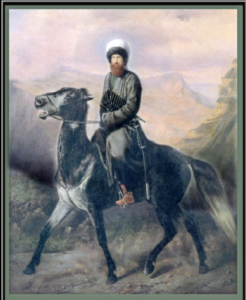
Raging, the Russians rampaged through Lower Chechenya, burning crops, and destroying sixty-one villages. Slowly, the Chechen and Daghestani murids retreated to the mountains behind them. Ghazi Mollah and his leading disciple Shamyl decided to make a stand at Ghimri. After a bitter siege, with many casualties on both sides, the aoul was stormed by the Russians troops, who found Ghazi Mollah among the dead. Still seated on his prayer-carpet, the Imam, uncannily, kept one hand on his beard, and the other pointing to the sky. But in the meantime, his deputy, fighting with sixty murids in defence of two stone towers, seemed invincible, picking off with unerring aim any Russian who came near. At last, when only two Murids remained alive, Shamyl emerged, to imaugurate a reputation for heroism in combat which would resound throughout the Muslim Caucasus. As a Russian officer described the incident:
It was dark: by the light of the burning thatch we saw a man standing in the doorway of the house, which stood on raised ground, rather above us. This man, who was very tall and powerfully built, stood quite still, as if giving us time to take aim. Then, suddenly, with the spring of a wild beast, he leapt clean over the heads of the very line of soldiers about to fire on him, and landing behind them, whirling his sword in his left hand, he cut down three of them, but was bayoneted by the fourth, the steel plunging deep into his chest. His face still extraordinary in its immobility, he seized the bayonet, pulled it out of his own flesh, cut down the man and, with another superhuman leap, cleared the wall and vanished into the darkness. We were left absolutely dumbfounded.
The Russians paid little attention to Shamyl’s escape, confident that with the destruction of the Murids capital they had achieved a final victory. They could not guess that thirty years of war, at a price of half a million Russian lives, awaited them at his hands.
After his dramatic escape from Ghimri, the wounded Shamyl painfully made his way to a saklia, a cottage in the glacier-riven heights of Daghestan. A shepherd sent word to his wife Fatima, who came secretly to him, and nursed him through a long fever, binding up eighteen bayonet and sword wounds. Months later, Shamyl was able once more to travel, and hearing of the death of Ghazi Mollahs successor, was acclaimed by the Muslims as al-Imam al-Azam, Leader of all the Caucasus.
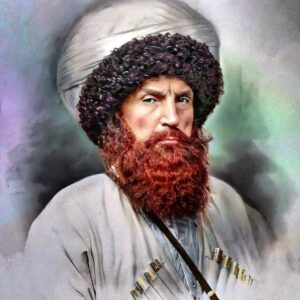
Shamyl had been born in 1796 to a noble family from the Avar people of southern Daghestan. Growing up with his friend Ghazi Mollah, he divided his austere childhood between the mosque and the narrow terraces around Ghimri, where he grazed his familys sheep. Often he would look over the edges, down into the five thousand foot abyss beneath the village, and watch the lightning flash in the thunderclouds below. In the further distance, on the slopes, could be seen the ghostly glow of naphtha fires, where natural oil came bubbling up through the stones, burning for years.
This harsh landscape, and the rigorous Caucasian upbringing which went with it, accustomed the future Imam to a life with few worldly pleasures. When only a child, he persuaded his father to abandon alcohol by threatening to fall on his own dagger if he did not stop. The difficult spiritual discipline required of him as a young scholar seemed to come naturally, and by his early twenties he was renowned for all the virtues which the Caucasus respected: courage in battle, a mastery of the Arabic language, Tafsir এবং ফিকহ, and a spiritual nobility which left a profound impression on all who met him.
Together with Ghazi Mollah, he became the disciple of Muhammad Yaraghli, the strict mystically-minded scholar who taught the young men that their own spiritual purity was not enough: they must fight to make Allah’s laws supreme. The Sharia must replace the pagan laws of the Caucasian tribes. Only then would Allah give them victory over the Russian hosts.
Shamyl’s first exploits as Imam were purely defensive. The Russians under General Fese had launched a new attack on Central Daghestan. Here, in the aoul of Ashilta, as the Russians approached, two thousand Murids took an oath on the Quran to defend it to the death. After a bitter hand-to-hand fight through the streets, the Russians captured and destroyed the town, taking no prisoners. The stage was set for a long and bitter war.
Shamyl was no stranger to war with Europeans. While performing the Hajj in 1828, he had met Emir Abd al-Qader, the heroic leader of Algerian resistance against the French, who shared with him his views on guerilla warfare. The two men, although fighting three thousand miles from each other, were very similar both in their scholarly interests and in their methods of war. Both realised the impossibility of winning pitched battles against the large and well-equipped European armies, and the need for sophisticated techniques for dividing the enemy and luring him into remote mountains and forests, there to be dispatched by quick, elusive guerilla attacks.
The weakness of Shamyl’s position in the Caucasus was his need to defend the aouls. His men, moving with lightning speed, could always dodge an enemy, or deal him a surprise blow from behind. But the villages, despite their fortifications, were vulnerable to Russian siege methods backed up with modern artillery.
Shamyl learnt this lesson in 1839, at the aoul of Akhulgo. This mountain fastness, protected by gorges on three sides, was itself divided into two by a terrifying chasm spanned by a seventy-foot bridge of wooden planks. Akhulgo had already filled with refugees fleeing from the Russian advance, and the presence of so many women and children to feed made the prospect of a long siege an ugly one. But he would retreat no further: here he made his stand.
By this time, the Naqshbandi army numbered some six thousand, divided into units of five hundred men, each under the command of a Naib (deputy). These Naibs, tough and scholarly, were a mystery to the Russians. In the thirty years of the Caucasian war, not one was ever captured alive. At Akhulgo, these men fortified the settlement as best they could, and then, in the evening after sunset prayers, went upon the roofs to sing Shamyl’s Zabur, the religious chant he had composed to replace the trivial drinking-songs they had known before. There were many other chants, too; the most familiar to the Russians being the Death Song, heard when a Russian victory seemed imminent and the Chechens tied themselves to each other, and prepared to fight to the end.
The Russian attack began on June 29. The Russians attempted to scale the cliffs, and lost three hundred and fifty men to the Mujahideen, who threw rocks and burning logs upon them. Chastened, the Russians withdrew for four days, until they could place their artillery so as to bombard the walls from a safe distance. But although the walls were pounded to rubble, each time the Russians attacked, the Murids appeared from the ruins of the aoul and threw them back with heavy casualties.
Conditions in the village, however, were becoming desperate. Many had died, and their bodies were rotting under the summer sun, spreading a pestilential stench. Food supplies were almost exhausted. Hearing this news from a spy, the Russian general, Count Glasse, decided on an all out assault. Three columns he directed to attack simultaneously, thereby dividing the defenders fire.
The first column, carrying scaling ladders, climbed a cliff on one side of a ravine. But from the apparently bare rocks on the opposing cliff, gunfire directed by Chechen sharpshooters decimated their ranks within minutes. The officers were soon all killed, and the six hundred men, their backs against the cliff, were left trapped by the Murids in the knowledge that exhaustion and exposure would finish them off before dawn.
The second column attempted to make its way to the aoul along the ravine floor. This too ended in disaster, as the defenders rolled down boulders upon them, so that only a few dozen returned. The third column, inching along a precipice, found itself attacked by hundreds of women and children who had been hidden in caves for safety. The women cut their way through the Russian ranks, while their children, daggers in both hands, ran under the Russians and slashed at them from beneath. Here, as always in Chechenya, the women fought desperately, knowing that they had even more to lose than the men. Under this screaming and bloody onslaught, the Russian column staggered and fell back.
Baffled, Count Glasse sent a messenger to Shamyl to arrange a parley. Conditions at the aoul were extreme, and Shamyl, with a heavy heart, struck a deal, agreeing to release his eight-year old son Jamal al-Din as a hostage, on condition that the Russian army departed and left the aoul in peace. But no sooner had the boy been put on the road to St Petersburg than the artillery barrage opened up again, and Akhulgo was once more pounded from every side. Shamyl realised that he had been duped.
The next day, the Russians advanced again on Akhulgo, and found it populated only ravens greedily feeding on corpses. The survivors had slipped away during the night. The only Muslims to remain, those too weak to withdraw, were discovered hiding in the caverns in the nearby cliffs, which were reached with the utmost difficulty. A Russian officer later recorded this as follows:
We had to lower soldiers by means of ropes. Our troops were almost overcome by the stench of the numberless corpses. In the chasm between the two Akhulgos, the guard had to be changed every few hours. More than a thousand bodies were counted; large numbers were swept downstream, or lay bloated on the rocks. Nine hundred prisoners were taken alive, mostly women, children and old men; but, in spite of their wounds and exhaustion, even these did not surrender easily. Some gathered up their last force, and snatched the bayonets from their guards. The weeping and wailing of the few children left alive, and the sufferings of the wounded and dying, completed the tragic scene.
Shamyl had made a desperate attempt to lead his family and disciples away during the night. His wife Fatima was eight months pregnant, and his second wife Jawhara was carrying her two month- old baby Said. But together they managed to inch along a precipice unknown to the Russians, until they reached the torrent below. Here, the Imam brought a tree down to form a makeshift bridge. Fatima crossed safely with her younger son Ghazi Muhammad; but Jawhara was spotted by a Russian sharpshooter, who killed her with a single bullet, sending her and her child toppling over to vanish into the raging torrent. Slowly, Shamyl, his depleted family, and the surviving Mujahideen, dodged the Russian patrols, who were now being aided by the Ghimrians who had gone over to the Russian side. Once they encountered a Russian platoon, and in the ensuing fight the young Ghazi Muhammad received a bayonet wound. But Shamyl’s sword accounted for the Russian officer, whose men fled in terror. They were free again: as at Ghimri, the Imam had effected a miraculous escape.
Count Grabbes report described the capture of Akhulgo in glowing terms. The Murid sect, he wrote, has fallen with all its followers and adherents. The Tsar was delighted; but again, the Russian celebrations were premature. While Shamyl was free he was undefeated. And Moscow had once again given the Caucasus reason to seek freedom.
In 1840, Shamyl raised a new army, and again unfurled his black banners. With the Russians falling back along the Black Sea coast in the face of a Circassian uprising, conditions were right for a major campaign, and by the end of the year, the Imam had retaken Akhulgo, and led his forces onto the plains of Lower Chechenya, capturing fort after fort. The Russian response was chaotic: one sortie led by Grabbe resulted in the death of over two thousand Russians. A new commander, the Tsars favourite General Neidhardt, promised to exchange <Shamyl’s head for its weight in gold to anyone who could capture him; but all in vain. Again and again the Imperial legions were drawn into the dark forests, divided, and annihilated.
Shamyl’s techniques, meanwhile, were improving all the time. On one occasion, he attacked a Russian position with ten thousand men, only to reappear less than twenty-four hours later fifty miles away, to attack another outpost: an astonishing feat. One military historian has written: The rapidity of this long march over a mountainous country, the precision of the combined operation, and above all the fact that it was prepared and carried out under the Russians very eyes, entitle Shamyl to rank as something more than a guerilla leader, even of the highest class.
Russia’s next move was a bold attack by ten thousand men on <Shamyl’s new capital of Dargo. The commander, General Vorontsov, drove through Chechenya and Central Daghestan, encountering little resistance, and finding that Shamyl had burnt the aouls rather than allow them to fall into his hands. Confident, and contemptuous of the Asiatic rabble, he decided to lunge through the final ten miles of forest that separated him from Dargo and Shamyl’s warriors. But when the Russians arrived, again to find that Shamyl had fired the aoul, and turned to retrace their steps, disaster overtook them. Shamyl had watched their advance through his telescope, and calmly directed his Murids to take up positions from which to ambush and harry the Russians. Fighting alongside the Muslims were six hundred Russian and Polish deserters, who dismayed the Russian troopers by singing old army songs at night, their mocking voices rising eerily from the hidden depths of the forest.
Shamyl had positioned four cannon slightly above the devastated aoul, and the Russians charged these and took them with little difficulty. But their way back lay through cornfields that concealed dozens of Murids, who stood up to fire, hiding themselves again before the dazed Russians could shoot back. A hundred and eighty-seven men died before the remains of this column rejoined the main army. Not even the bayoneting of the Chechen prisoners could raise Russian spirits after this omen of impending disaster.
The Russians now began to retreat back through the forest. But the woods were now alive with unseen foes. Slippery barricades blocked their way, and forced them to leave the paths, slashing their way towards ambuscades and bloody confusion. Hundreds of Russians died, including two generals. Heavy rain turned the paths to mud, and made rifles useless, so that at times the two sides fought silently with stones and bare hands. To escape the invisible snipers, the terrified Vorontsov himself insisted on being carried inside an iron box on the shoulders of a colonel. Thus trapped, with over two thousand wounded, and with only sixty bullets left apiece, the desperate Russians sent messengers to General Freitag at Grozny, begging for reinforcements.
At this crucial moment, Imam Shamyl received news that his wife Fatima was dying. He immediately gave orders for the continuing of the battle, and left for the day-long journey to the aoul where she lay. After holding her in his arms as she died, he rode back, to discover, to his deep distress, that his men had disobeyed him. Melting away at the sight of Freitags troops, they had allowed Vorontsovs column to limp out of the forest without further loss. Shamyl boiled with fury, and he fiercely denounced those who had shown faintheartedness instead of clinching the victory. But Russia had paid dearly, as the forest soil of Dargo folded around the bodies of three generals, two hundred officers, and almost four thousand infantrymen. Even today, Russian soldiers remember the Dargo catastrophe in a gloomy song: In the heat of noonday, in the vale of Daghestan, With a bullet in my heart, I lie …
For another ten years, Shamyl’s flags flew over Chechenya and Daghestan, proclaiming what Caucasians still refer to as the Time of Sharia. The Tsar, fuming in his vast palace in St Petersburg, received message after courteous message from his generals praising their own victories; yet still Shamyl ruled. Vorontsov, Neidhardt and others were recalled, and died in gilded obscurity. But in 1851, command was given to a younger man, General Beriatinsky, the Muscovy Devil who was to change the course of the war for ever.
The new Russian commander knew his enemy, and adapted his techniques accordingly. He knew that the Chechens disliked going into battle unless they had performed their ওযু-ablutions, so he ensured that great dams were built to cut off the water supply to his opponents. He adopted a policy of bribing villages into accepting Russian authority, and delayed the enserfment process indefinitely. He ended the former policy of informally butchering women and children during the capture of aouls. But his most significant innovation was his long, slow campaign against the forests. Like the Americans in Vietnam and the French in Algeria, he realised that his enemy could only be defeated on open ground. He thus deputed a hundred thousand men to cut down the great beech trees of the region. Some were so vast that axes were inadequate, and explosives had to be used instead. But slowly, the forests of Chechenya and Daghestan disappeared; while Shamyl, watching from the heights, could do nothing to bring them back.
In 1858, the last great battle erupted. The Ingush people, driven from their aouls by the Russians into camps around the garrison town of Nazran, revolted, and called on Shamyl for aid. He rode down from the mountains with his mujahideen, but sustained a crippling defeat under the cannon of a relief column sent to support the beleaguered garrison. When he returned to the mountains, he found the support of his people beginning to melt away. Whole aouls went over to the Russians rather than submit to siege and inevitable destruction. Even some of his most faithful lieutenants deserted him, and guided Russian troops to attack his few remaining redoubts.
In June 1859, Shamyl retreated to the most inaccessible aoul of all: Gounib. Here, with three hundred devoted Murids, he determined to make a last stand. The Russians were driven back time and again; but finally, after praying at length, and moved by Beriatinskys threat to slaughter his entire family if he was not captured alive, he agreed to lay down his arms.
Thus ended the Time of Sharia in the Caucasus. The Imam was transported north to meet the Tsar, and then banished to a small town near Moscow. Here he dwelt, with a diminishing band of family and relations, until 1869, when the Tsar allowed him to leave and live in retirement in the Holy Cities. His last voyage, through Turkey and the Middle East, was tumultuous, as vast crowds turned out to cheer the Imam whose name had become a legend throughout the lands of Islam.
His son Ghazi Muhammad, released from Russian captivity in 1871, travelled to meet him at Makka. He arrived, however, when the Imam was away on a visit to Madina. As he was walking around the Holy Kaba, a tattered, green-turbaned man came up and suddenly cried, “O believers, pray now for the great soul of the Imam Shamyl!”
It was true: on that same day, Shamyl, murmuring “Allah! Allah!,” had passed on to eternal life in Paradise. He was buried, amid great throngs and much emotion, in the Baqi Cemetery. But his name lives still; and even today, in the homes of his descendents in Istanbul and Madina, in flats whose walls are still adorned with the faded banners of black, mothers sing to their children words which will be remembered for as long as Muslims live in Chechenya and Daghestan: